
Electrochemistry in Non–aqueous Systems
Double–layer charging in ionic liquids
The electrochemical double-layer in Ionic liquids (i.e., room temperature molten salts) differs significantly from aqueous solutions, as there is no solvent involved. We studied the DL charging and layer formation in IL on Au(111) by EC microcalorimetry [1] and STM tunneling barrier height measurements.
Lithium deposition
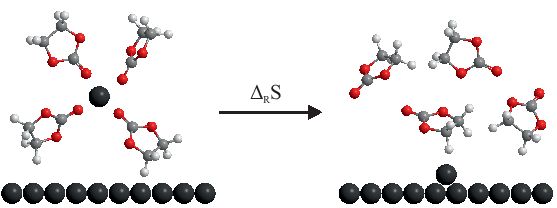
We investigated the lithium bulk deposition from a standard battery electrolyte, e.g. a solution of LiPF6 in a 1:1 mixture of ethylene carbonate and dimethyl carbonate by microcalorimetry [2, 3]. From the reaction entropy of the metal bulk deposition we obtained information on the Li solvation and ion pairing in solution.
Sodium deposition
As part of the POLIS cluster of excellence, we study new and promising battery systems. One example is Na metal deposition, where we are interested in the solvation of sodium, the growth mechanisms and SEI-formation.
[1] J. Lindner, F. Weick, F. Endres, and R. Schuster, Entropy Changes upon Double Layer Charging at a (111)-Textured Au Film in Pure 1-Butyl-1-Methylpyrrolidinium Bis[(trifluoromethyl)sulfonyl]imide Ionic Liquid, J. Phys. Chem. 124, 693-700 (2020).
[2] M. J. Schmid, K. R. Bickel, P. Novák, and R. Schuster, Mikrokalorimertrische Messung des Lösungsmittelbeitrags zur Entropieänderung bei der elektrochemischen Lithiumvolumenabscheidung, Angew. Chem. 125, 13351-13371 (2013).
[3] M. J. Schmid, J. Xu, Jeanette Lindner, Petr Novák, and R. Schuster, Concentration Effects on the Entropy of Electrochemical Lithium Deposition: Implications for Li+ Solvation, J. Phys. Chem. B 119 13385 - 13390 (2015).